
Effective sampling is one of the biggest challenges for field biologists around the world–particularly for marine biologists who need to take samples in hard-to-access environments. These issues are compounded when researchers study species that are protected and must not be harmed or removed from the environment.
As collecting genomes from all marine organisms–even those which may be protected–is the cornerstone of the Ocean Genome Legacy’s (OGL) mission as a biorepository, OGL Director Dan Distel understands this problem well. During the spring of 2018, he joined forces with Dr. Timothy Lannin, an assistant teaching professor in Northeastern University’s Bioengineering Department, with a proposal for students to develop a method for sampling DNA from fish in the wild without capturing or harming them.
Five Northeastern bioengineering seniors answered the call: Sule Sahin, Zihang Fang, Aspasie Song, Catherine Luo, and Mackenzie Coleman became the Fish DNA Team. During the next nine months, they designed and built a non-invasive underwater fish DNA sampling device.

Meet the Fish DNA Team (left to right): Dr. Timothy Lannin, Catherine Luo, Aspasie Song, Mackenzie Cole, Sule Sahin, Zihang Fang, and OGL staff Hannah Appiah-Madson and Rosie Falco with the DNA sampling device.
According to the team, it is “an autonomous underwater device that non-invasively collects fish body mucus and scales. The user submerges the device in water for extended periods to allow it to passively sample DNA from fish species in the environment.” The device can be adjusted to accommodate larger or smaller target fish species, and a camera mounted on top of the sampling device allows users to see the individual fish that enter the device and are sampled.
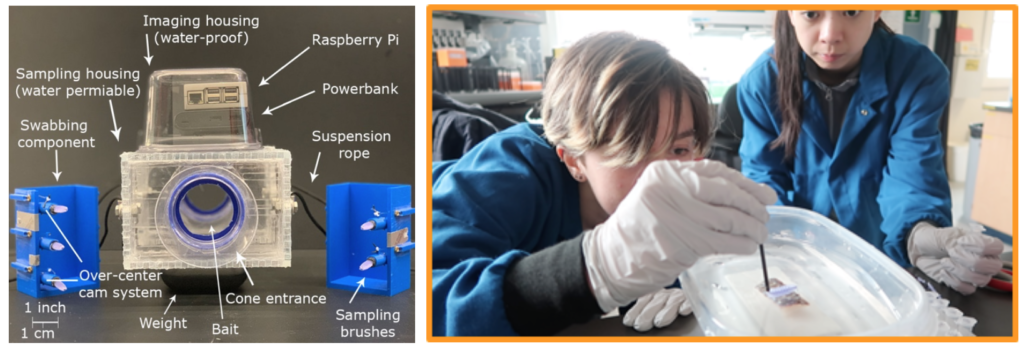
Most importantly, the Fish DNA team gained firsthand experience about the critical intersection of bioengineering and marine science. Want to contribute to sampling those hard-to-access species while supporting creative education projects? Make a gift to support OGL’s collection and mentoring missions.