
Emily Stangel, Collections Assistant and Dan Distel, Director
August 10, 2026
With research budgets tightening and environments changing at a record pace, a new generation of environmental researchers is learning to collaborate to amplify their research impact and stretch their research dollars. This year, OGL is proud to help by launching the OGL Doctoral Ocean Collections (DOC) Award.
The DOC Award provides two Northeastern University graduate students with up to $1,000 to support research projects conducted in collaboration with OGL. Funds may be used for discretionary, non-capital expenses, such as DNA sequencing, DNA extraction kits, field site travel, and sampling equipment. Throughout the project, collected samples and data are deposited in the OGL collection, making them available to support other critical research projects.
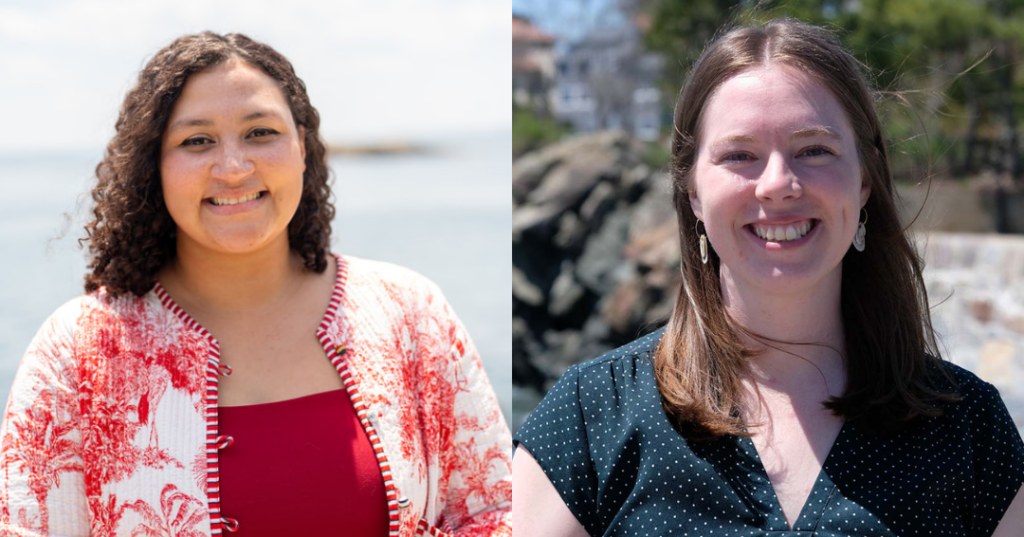
Our inaugural recipients are Angela Jones and Marcella Heineke, two outstanding Marine and Environmental Science PhD students whose exceptional work earned them this distinction!
Meet the Recipients
Angela Jones is a PhD candidate in the Helmuth and Patterson Labs at Northeastern University’s Marine Science Center. Her dissertation research sits at the intersection of morphology, ecology, and genetics and focuses on one of the Gulf of Maine’s most iconic and ecologically critical animal groups: sea stars.
Despite being studied for over 150 years, two species of sea stars (Asterias rubens and Asterias forbesi) are so similar in appearance that they are nearly indistinguishable. Even rigorous diagnostic criteria have failed to reliably tell them apart. Angela is working to change that by combining detailed morphological measurements, site-location data, and genetic analyses to better characterize variation within and between the two species across their ranges in the Gulf of Maine.
Why is this important? Sea stars are critical predators that help maintain ecological balance in rocky coastal communities. However, over the past decade, they have faced a new threat, Sea Star Wasting Disease, which has killed billions of sea stars along the North American coast. Angela’s research aims to understand the current genetic makeup of sea star populations and how they are responding to this new threat.
Angela’s samples, data, and high-resolution photographs of A. rubens and A. forbesi specimens will be added to OGL’s database to benefit researchers worldwide.
Marcella Heineke is a PhD candidate in the Kimbro Lab at Northeastern University’s Marine Science Center. Marcella’s dissertation addresses a fundamental question in evolutionary biology: why do members of the same species look and behave differently across their range? Are these differences shaped by genetics or by the environment? Her research focuses on Ascophyllum nodosum, the knotted-wrack seaweed that blankets rocky intertidal shores throughout the Gulf of Maine.
Why is this important? Ascophyllum nodosum is a commercially harvested species worth over $1 million annually in Maine, but the importance of Marcella’s work goes far beyond this. Genetic diversity makes species more stable and better able to cope with threats. To effectively protect species, conservation managers need to understand how that diversity is distributed across its range. Marcella’s work helps researchers and conservation managers understand how genetics and environment combine to create sustainable populations.
With support from the DOC Award, Marcella will expand her genetic analysis to a whole-genome approach and produce the first population genetics dataset of its kind for A. nodosum in the Gulf of Maine. Because extracting DNA from brown algae is notoriously difficult, Marcella’s samples in the OGL collection will lower the barrier for future researchers building on this work.
The positive impact of these projects is made possible through the generous support of our donors. If you would like to learn more and help OGL study and protect the ocean’s biodiversity, support OGL here.